
Client
XPLR Inc
Services
Social travel UX Product design UX strategy Research UX/UI design Onboarding
Year
2025
Role
Product Designer
XPLR is a social travel platform that connects people through shared journeys, compatible travel styles, group planning, and meaningful experiences. It integrates travel profiles, trips, bucket lists, groups, activities, events, maps, messaging, discovery, and community content into one mobile app.
The product has a strong opportunity to use artificial intelligence. By leveraging AI, XPLR can provide users with more accurate and personalized recommendations for travelers, activities, places, groups, and future trips, helping users find better matches and plan trips that align with their interests. By using profile data, travel preferences, dates, destinations, saved places, and social behavior, the platform can continuously suggest more relevant and meaningful experiences, making trip planning and social connections easier and more tailored to each individual.
The problem
When I came on board, there was an initial app version, but it had confusing, incomplete flows and usability issues.
My role was to redesign it. Not only that, but through my process, I helped improve the product strategy, clarify the feature architecture, and help turn a complex set of ideas into clearer user flows. I asked product-defining questions, analyzed competitors, identified confusing areas, and helped shape the app around connection, trust, and shared travel intent.
The goal was to make XPLR feel less like a collection of travel features and more like a coherent social travel ecosystem.

Strategic direction
The client had a strong vision: to connect travelers through shared experiences, not just destinations.
My contribution was to clarify and streamline the vision. The product had many parts: trips, groups, activities, events, profiles, maps, feeds, bucket lists, connections, and recommendations. Some overlapped, so the main strategic work was to define each one and how they interact.
The product direction became clear: XPLR should help people find ideal travel companions, plan together, and preserve travel memories in a trusted space.
That meant prioritizing connection over content. A trip should not be only a post. A group should not be only a chat. An activity should not be only an event. Each object in the app should help users move toward shared travel.
Competitive research and product opportunity
I analyzed products such as TripBFF, Nomadtable, and Fairytrail to understand what travelers already love and what frustrates them.
Key signals were clear. Users want to meet like-minded travelers, search by date and location, join groups, plan activities, message easily, and see connections before committing.
Main pain points: weak safety controls, poor filtering, unclear group management, hidden messages, lack of verification, and premature or obstructive monetization.
This gave XPLR a strong opportunity: become the safer, more thoughtful, better-structured platform for shared travel planning.
AI can further strengthen this direction by providing smarter matching between users based on specific interests, making personalized activity suggestions, offering local recommendations tailored to user profiles, suggesting compatible trip companions based on overlapping preferences and travel histories, and introducing discovery patterns, such as showing that “people like you are planning this.” These features give users a seamless way to find the most suitable people and experiences. However, these benefits require a clean product structure first.

Improvements
Improving the social layer
XPLR depends on trust. People are not only browsing places. They are deciding whether they feel safe enough to connect, chat, join a group, or meet during a trip.
I pushed for clearer visibility and privacy controls. Users should know who can see their trips, who can join groups, who can message them, and what happens after connecting.
Based on research, I recommended group features such as seeing group members before joining, approving requests, removing members, and making groups invite-only or hidden. Competitor reviews showed that these controls matter especially to solo travelers and women.
Verification was planned for a later phase, but the structure needed to accommodate it. Trust cannot be added as an afterthought. It needs to be part of the product architecture.
Profile, onboarding, and matching
The profile needed to support better matching, not only identity.
We have onboarding fields that help people connect more meaningfully: nationality, age, languages, bio, travel preferences, photos, captions, and prompts. Short prompts can convey personality quicker than long profile text, and they support the emotional side of matching. The design challenge was to add all this without increasing cognitive load.
The onboarding needed to stay light, but useful. The app should collect enough information to support trust and future AI recommendations without making setup feel heavy.
In the long term, XPLR can use artificial intelligence to match users based on overlapping dates, destination intent, travel style, interests, group preferences, and past behavior, giving users more relevant travel companions and experiences. This level of matching will help users quickly find others with compatible plans and interests, streamlining the process of forming groups or finding travel partners.
Map, feed, and discovery
The map can support place discovery, trip context, nearby plans, and public posts. But color-coded filters alone can become confusing, so we have clearer labels and prompts.
The feed shares community content: recommendations, questions, trip updates, and public plans. A user might ask, 'Traveling to Paris with kids. Any suggestions?' This keeps the product active between trips and gives the system more context for recommendations.
Over time, this approach creates a rich data layer that supports smarter discovery. By leveraging artificial intelligence, XPLR can help users find better places, people, and timing, as well as group suggestions, based on their preferences and app activity, resulting in more personalized recommendations and an easier planning experience.

My strategic contribution
My work went beyond UI changes. I clarified product logic.
I asked questions that exposed unclear areas: trip location, bucket lists becoming trips, adding connections, group permissions, activity-trip relations, public profile designs, onboarding-matching support, and connecting feed posts to map and discovery.
These questions helped turn a broad product vision into actionable flows.
I also shaped microcopy to be more human, social, and purposeful. The product needed a warm, clear tone, not a transactional one. I used AI tools to write onboarding and trip-creation copy, present statuses clearly, and guide users through error recovery.

The biggest design contribution was turning a broad product vision into clear, actionable product logic across trips, groups, discovery, profiles, and future AI-powered matching.
Deliverables
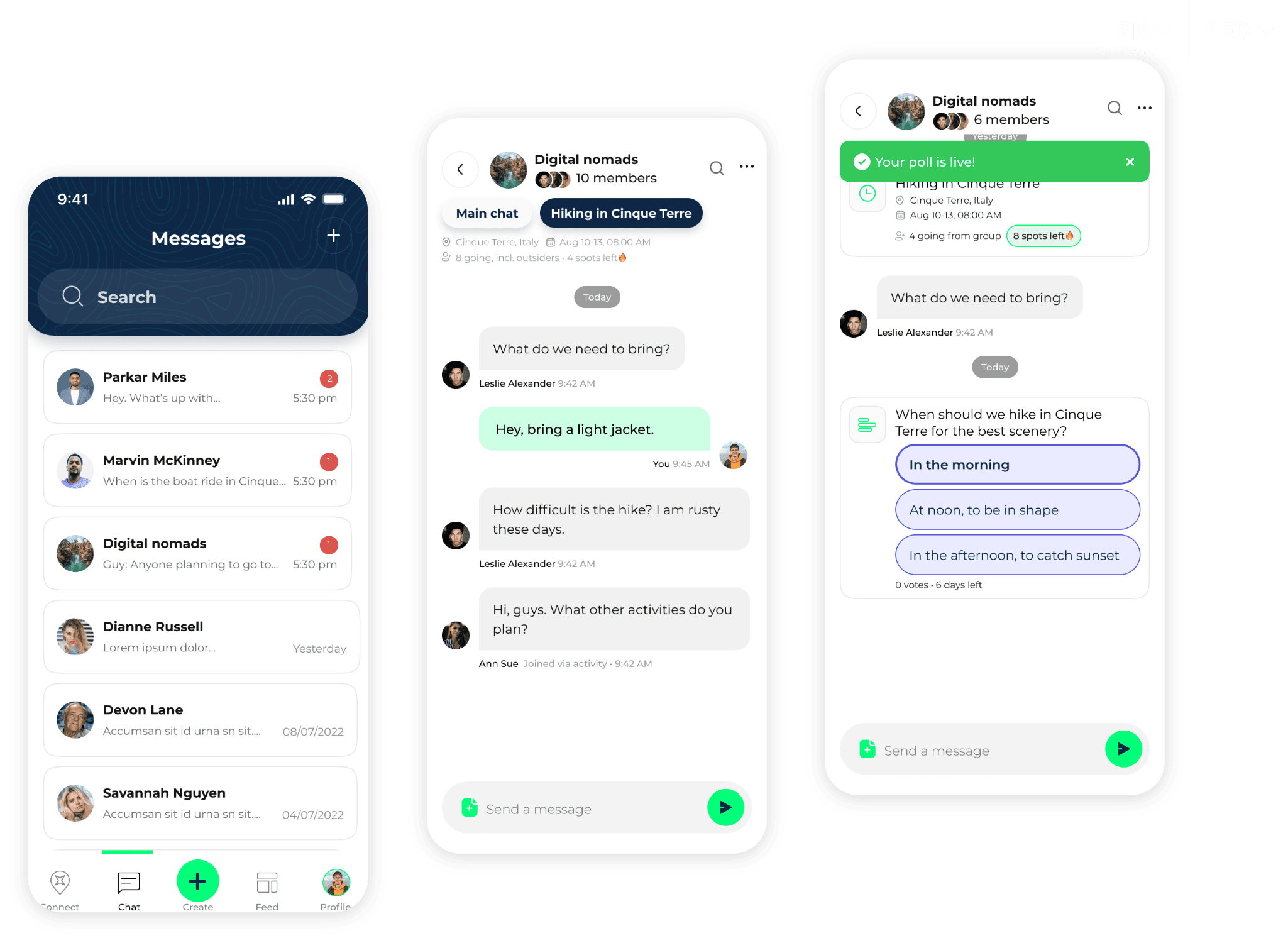
My work included competitive analysis, UX strategy, product flow clarification, onboarding and profile strategy, trip and group logic, map and feed recommendations, microcopy guidance, and design support for updated mobile flows.
We defined a clearer structure for trips, groups, activities, profiles, discovery, and trust features to support future AI-powered matching and recommendations.
Outcomes and long-term value
The project repositioned XPLR as a shared-experience travel platform built on connection, compatibility, and trust.
The greatest value was strategic clarity. The product had promising ideas, but needed a stronger structure to unite them.
I helped organize a complex product vision, addressed unclear flows, improved the product model, and connected UX decisions to long-term platform value.
XPLR: Travel platform · Product design, UX strategy, UX/UI design · 2025